
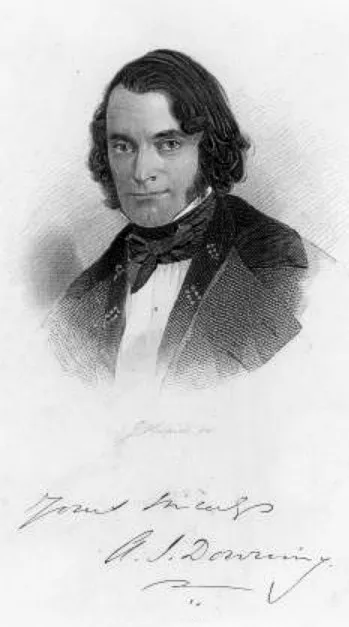
Andrew Jackson Downing shaped the physical landscape and aesthetic identity of 19th-century America as a pioneering landscape designer, horticulturist, and writer. Born in Newburgh, New York, in 1815, he spent his early years working in his family's nursery before cultivating a profound passion for botany, architecture, and landscape gardening.
His career surged with the 1841 publication of his landmark book, A Treatise on the Theory and Practice of Landscape Gardening, which stood as the first work of its kind in the United States. Through his writings and pattern books, he championed the integration of functional beauty in domestic architecture, popularizing Gothic Revival and picturesque styles.
Related Stories

Get the Latest Sports News from Seymour's Bird
Receive the latest updates on football, basketball,and technology news directly in your inbox. It's free!
SubscribeAs editor of The Horticulturist magazine from 1846 until his tragic death in 1852, Downing wielded immense cultural influence, famously advocating for the creation of major public green spaces like New York City's Central Park. His professional partnership with English architect Calvert Vaux further cemented his status as a visionary designer of monumental public grounds.
Tragically, his life was cut short at age 36 during the infamous steamboat fire on the Henry Clay in July 1852. Despite his untimely death, his foundational ideas lived on through his disciples and collaborators, fundamentally altering how Americans interact with nature and urban public design.
Transforming the National Mall and Architecture
President Millard Fillmore commissioned Downing in 1851 to redesign the National Mall in Washington, D.C., breaking away from Pierre Charles L'Enfant's rigid classical geometry. Downing envisioned a naturalistic landscape featuring interconnected parks and winding walking paths.
Although federal funding constraints prevented the complete realization of his ambitious Mall blueprint, his core design principles influenced federal landscaping choices for decades. His philosophy insisted that country residences and public buildings must harmonize seamlessly with their natural surroundings.
Collaborating closely with Calvert Vaux and Frederick Clarke Withers, Downing designed prestigious residential properties throughout the Hudson Valley for elite patrons and merchants. Their architectural pattern books provided everyday homeowners with accessible guidance on tasteful interior decoration and structural design.
Memorialized through landmarks like Downing Park in Newburgh and the commemorative urn near the Smithsonian Castle, his contributions continue to define the bedrock of American landscape architecture and horticultural heritage.