
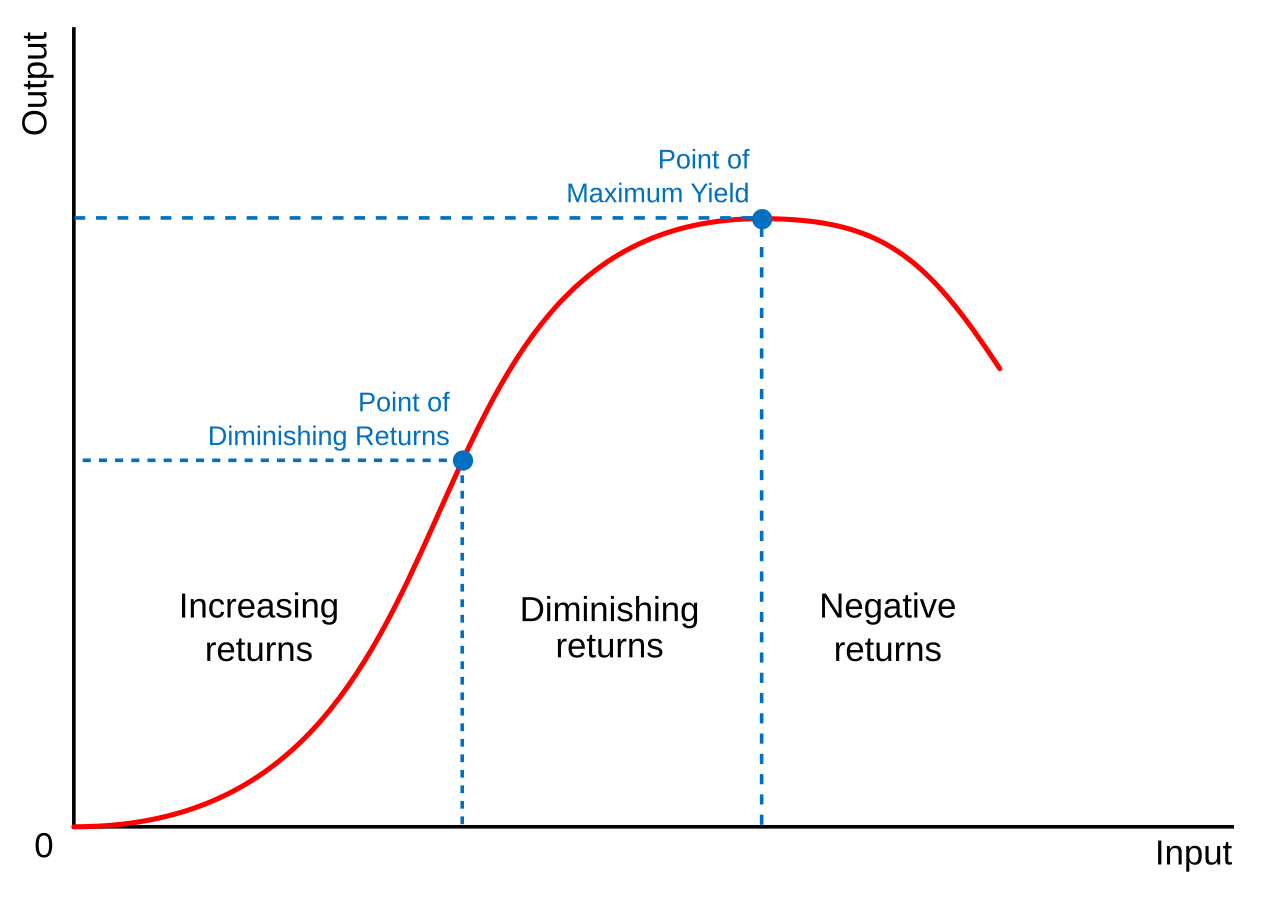
Diminishing returns means the decrease in marginal output of a production process as the amount of a single factor of production is incrementally increased while holding all other factors equal. The law of diminishing returns, also known as the law of diminishing marginal productivity, states that if a factor of production continues to increase while keeping other production factors constant, a further incremental unit of input will eventually return a lower amount of output. This principle does not imply a decrease in overall production capabilities, but rather defines a point on a production curve where producing an additional unit of output results in lower efficiency.
The historical roots of this economic concept trace back to early classical economists including Johann Heinrich von Thünen, Jacques Turgot, Adam Smith, and David Ricardo. In 1815, economists applied the concept of diminishing returns to land rent to investigate why grain prices were exceptionally high following the Napoleonic Wars. Classical economists attributed the successive diminishment of output to decreasing input quality, whereas neoclassical economists assume identical units of labor that disrupt the production process when added to fixed capital.
Related Stories

Get the Latest Sports News from Seymour's Bird
Receive the latest updates on football, basketball,and technology news directly in your inbox. It's free!
SubscribeA classic real-world example of diminishing returns is observed on a factory floor when adjusting workforce capabilities while keeping capital constants like machinery and warehouse space fixed. While initial additions of labor may yield increasing or constant returns, eventually overcrowding occurs where workers get in each other's way, causing productivity and efficiency to decline. At an even later stage, adding more employees can actually decrease overall production, resulting in negative returns.
The fundamental mechanics of diminishing returns dictate an inverse relationship between input returns and the cost of production. As marginal returns diminish due to fixed constraints, the marginal cost and average cost of output increase correspondingly. Recognizing the optimal level before returns begin to diminish allows producers to alter other variables in the production function rather than continually scaling a single input like labor.
Mathematical Models and Modern Economic Relevance
Mathematical formulations of production functions express output as a function of multiple inputs including natural resources, labor, capital, and technology. To demonstrate diminishing returns mathematically, two primary conditions must be satisfied where the marginal product remains positive while simultaneously decreasing. Economists also use elasticity functions to evaluate small input changes and define the efficiency boundaries of production processes.
Modern economic societies since the 1970s have sought to redefine the classical theory to accommodate multiple outputs, co-production, and technological innovations. Innovations such as technological advances or managerial progress can minimize or temporarily eliminate diminishing returns to restore productivity and generate profit. Furthermore, the principle extends beyond traditional manufacturing into macroeconomic indicators and human development metrics, such as the diminishing rate of return of income on overall well-being.
Constraints such as limited resource availability and capitalization prevent exponential growth from continuing indefinitely across various domains, including human population trends and economic development. These natural and structural boundaries ensure that growth eventually reaches a point of maximum yield on the curve where marginal output stagnates. Understanding these constraints helps economists analyze opportunity costs and the bowed-out shape of production possibilities frontiers.
The ongoing evolution of production theory ensures that the law of diminishing returns remains a cornerstone of both microeconomics and macroeconomics. By carefully analyzing the fine structure of inputs, disposability, and cost mechanics, businesses and policymakers can better navigate efficiency limits. Ultimately, recognizing when additional inputs yield reduced benefits remains vital for sustainable economic planning and resource allocation.