
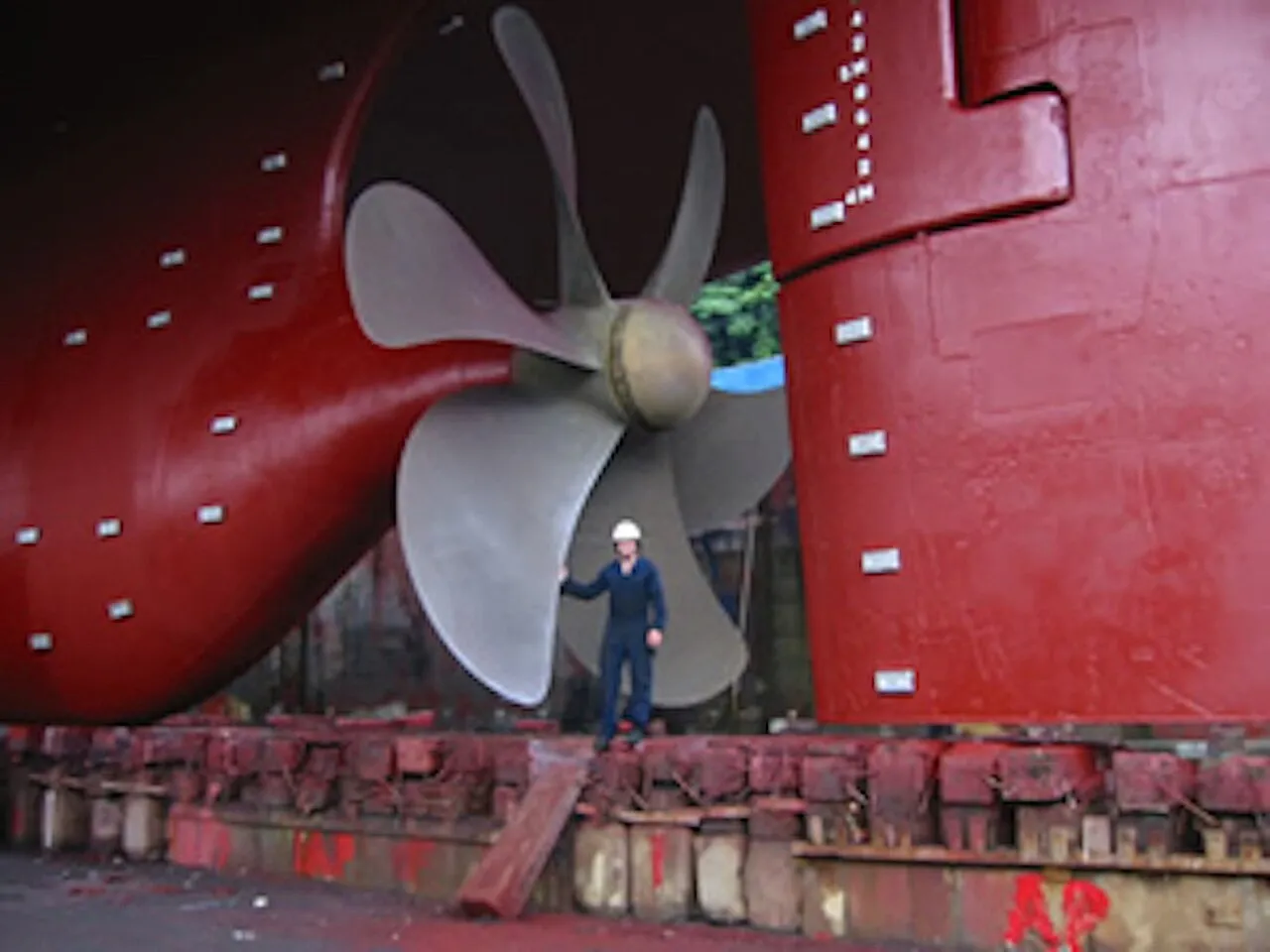
The propeller stands as one of the most critical engineering inventions in human history, driving both maritime vessels and aircraft forward through fluid dynamics. While modern designs rely on complex aerodynamic and hydrodynamic principles, the fundamental concept traces its roots back thousands of years to ancient innovations.
Early iterations of the screw mechanism can be found in Ancient Mesopotamia, where cuneiform inscriptions detail bronze water screws used by King Sennacherib. Later, the Greek polymath Archimedes popularized the spiral design for lifting water, giving rise to the famous Archimedes screw that inspired generations of inventors.
Related Stories

Get the Latest Sports News from Seymour's Bird
Receive the latest updates on football, basketball,and technology news directly in your inbox. It's free!
SubscribeAs centuries progressed, visionaries like Robert Hooke, James Watt, and David Bushnell experimented with spiral oars and early screw mechanisms for water propulsion. Bushnell notably integrated a hand-turned brass propeller into the historic Turtle submarine during the American Revolutionary War, marking a significant milestone in underwater navigation.
The 19th century witnessed a dramatic acceleration in propeller development, highlighted by the pioneering work of John Ericsson and Francis Pettit Smith. Their independent efforts eventually led to the construction of the SS Archimedes, the world's first steamship driven by a screw propeller, which fundamentally transformed commercial and naval shipping.
Evolution of Propellers in Aviation and Science
The dawn of aviation brought new challenges that shifted propeller design from maritime applications to the skies. Pioneers like the Wright brothers recognized that an aircraft propeller functioned essentially as a rotating wing, utilizing twisted aerofoil shapes to maintain a constant angle of attack.
Through rigorous wind tunnel testing, the Wright brothers engineered blades that rivaled modern efficiencies, proving that low-speed propeller aerodynamics could be precisely calculated. Other early aviators, such as Alberto Santos Dumont, experimented with alternative materials like aluminum to craft lightweight air screws.
Concurrently, theoretical physicists developed mathematical frameworks to better understand propeller performance. W.J.M. Rankine, A.G. Greenhill, and R.E. Froude formulated the momentum theory, modeling the ideal propeller as an infinitely thin disc inducing constant axial velocity.
Today, the legacy of these historical breakthroughs endures across global transportation networks. From massive cargo ships navigating open oceans to advanced aircraft soaring through the stratosphere, the continuous refinement of propeller technology remains a cornerstone of modern engineering.