
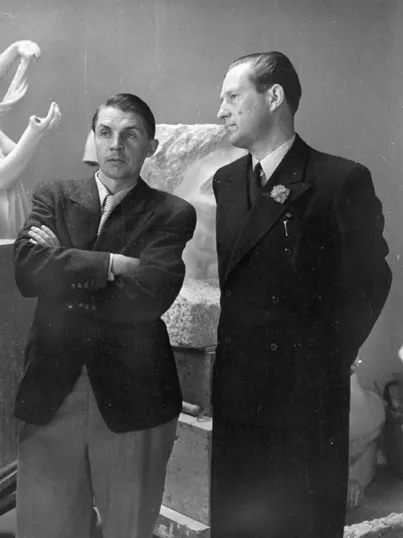
Viljo Revell stands as a monumental figure in modern architecture, renowned globally for his contributions to the functionalist school and his breathtaking structural designs. Born in Vaasa in 1910, Revell graduated from the Helsinki University of Technology in 1937, swiftly launching a career that would redefine urban landscapes across borders. His early breakthrough came alongside fellow students when they won the competition for the iconic Lasipalatsi in Helsinki, establishing his reputation for sleek, white functionalist design.
Throughout his prolific career, Revell crafted enduring commercial and civic structures, including the Teollisuuskeskus which houses the Palace Hotel, completed in time for the 1952 Helsinki Olympic Games. However, his defining international achievement was winning the prestigious 1956-1958 architectural competition to design the futuristic Toronto City Hall in Canada. Former Toronto Mayor Nathan Phillips famously praised Revell's winning concept as "breath-taking" upon its announcement, cementing the architect's legacy on the world stage.
Related Stories

Get the Latest Sports News from Seymour's Bird
Receive the latest updates on football, basketball,and technology news directly in your inbox. It's free!
SubscribeBeyond his architectural prowess, Revell's life was marked by remarkable resilience and historical involvement, including serving as a naval artillery fire control officer during World War II and surviving the tragic sinking of the Finnish flagship Ilmarinen. In the post-war era, he collaborated with prominent peers like Alvar Aalto to revolutionize building standards through the Finnish Building Information File, contributing significantly to modern construction standardization and architectural efficiency.
Revell's legacy lives on through his celebrated works, which continue to inspire contemporary designers and urban planners worldwide. Although his life was cut short by his premature death in 1964 before the completion of Toronto's City Hall, his visionary structures—ranging from the iconic City-Center in Helsinki to his innovative residential designs—remain enduring testaments to a master builder who forever changed the face of modern architecture.
Legacy of Modernism Across Finland and Canada
Viljo Revell left an indelible mark on Finnish and international architecture through a diverse portfolio of commercial buildings, civic centers, and residential projects. His works, such as the Didrichsen Art Museum villa in Helsinki and the striking Kudeneule knitwear factory in Hanko, showcase his versatility and commitment to functionalist principles. Each structure reflects a meticulous attention to light, space, and community integration.
The architectural masterworks designed by Revell continue to serve as vital cultural and civic hubs in their respective cities. In Helsinki, buildings like the "Sausage Building" or City-Center demonstrate his forward-thinking approach to urban commercial spaces, balancing aesthetic appeal with practical utility. These developments reshaped how citizens interact with downtown commercial environments.
In North America, Toronto's New City Hall remains his crowning international achievement, characterized by its distinctive curved towers and central council chamber. Commissioned alongside his design was Henry Moore's famous sculpture "Three Way Piece No. 2: Archer", which added a layer of artistic dialogue to the public square and sparked lively public discourse upon its installation.
Today, the architectural community continues to study and celebrate Viljo Revell's contributions to mid-century modernism. His ability to merge rigorous engineering standards with striking visual forms ensures that his buildings remain protected landmarks and cherished pieces of global architectural heritage.