
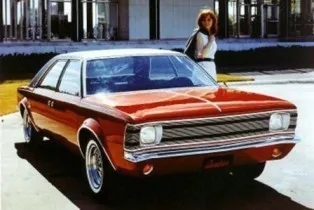
AMC Cavalier made waves across the automotive world when American Motors Corporation introduced the compact concept car in 1965 with a radical approach to manufacturing efficiency.
Designed by legendary stylist Dick Teague, the vehicle stood out for its striking symmetry and interchangeable body panels, including identical fenders on opposite corners and doors that could be swapped from side to side.
Related Stories

Get the Latest Sports News from Seymour's Bird
Receive the latest updates on football, basketball,and technology news directly in your inbox. It's free!
SubscribeBeyond its symmetrical novelty, the concept was engineered to slash tooling and production costs by up to thirty percent, showcasing a forward-thinking manufacturing philosophy that resonated throughout the industry.
Although it never reached mass production as originally envisioned, elements of its distinct styling cues and horizontal lines heavily influenced later production vehicles like the 1970 AMC Hornet.
Project Europa And The Global Vision

American Motors Corporation later explored expanding the innovative architecture internationally through Project Europa, aiming to create a compact world car tailored for European markets.
Dick Teague proposed adapting the Cavalier layout into a front-wheel-drive platform, noting that "the component interchangeability could significantly reduce European production overheads".
The ambitious global initiative sought to leverage local powertrains from European manufacturers while utilizing external contract assemblers to keep financial risks manageable for the automaker.
Despite receiving serious evaluations from management as a viable hedge against future fuel crises, the ambitious project was ultimately shelved, leaving the Cavalier a legendary automotive footnote.